
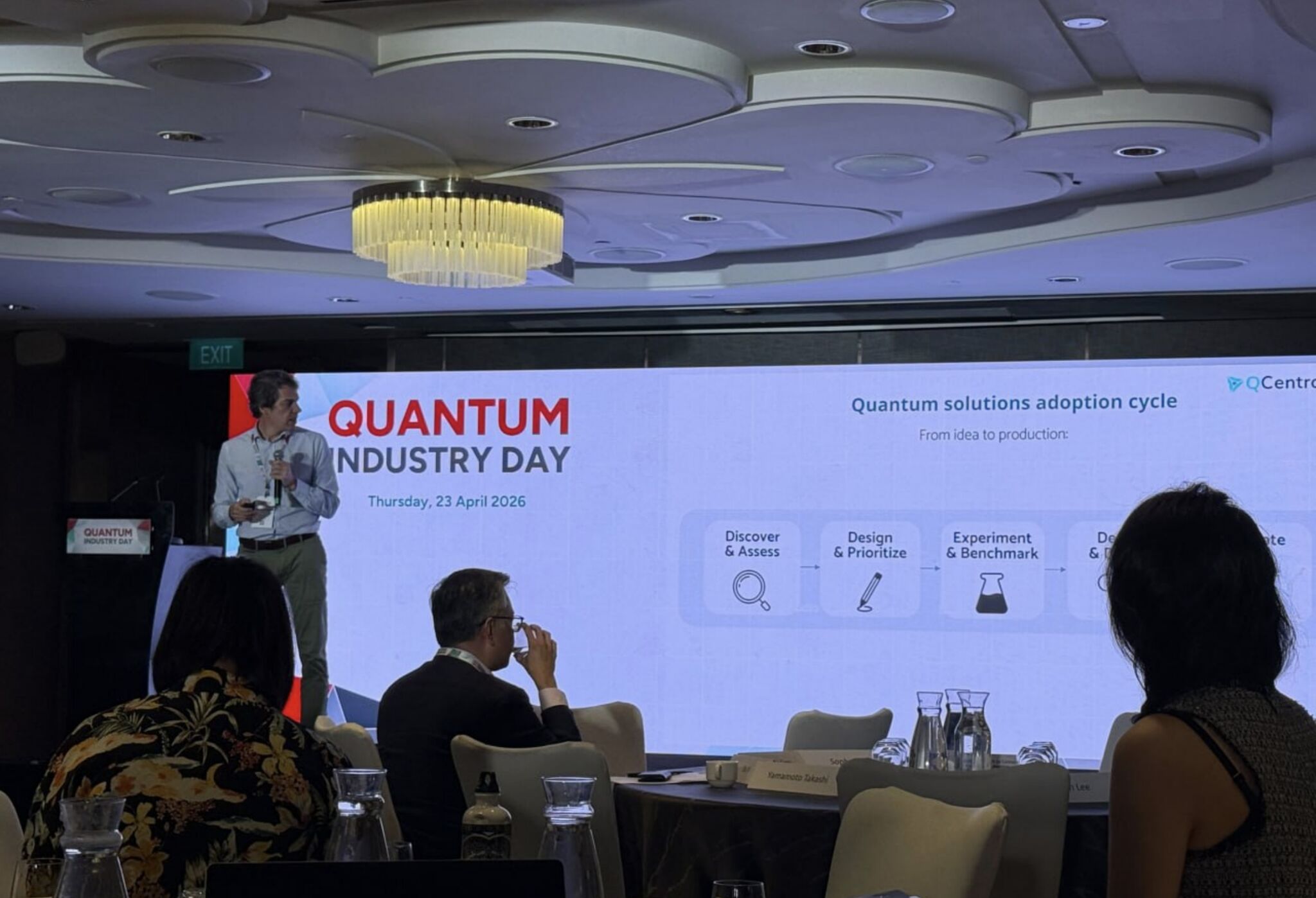
“How do we start?” is still the most common question financial institutions ask about quantum.
Last week at Quantum Industry Day 2026 in Singapore — hosted by the National Quantum Office and Quantinuum — our CEO, Carlos Kuchkovsky, gave two talks focused on answering exactly that. One framework, one practical model, and a fair amount of honesty about what quantum can and can’t do in production today.
Here’s the longer version of what was on stage.
The morning: a framework that doesn’t overcommit
The premise of the morning session was simple. Financial institutions don’t need to wait for fault-tolerant quantum hardware to start preparing — but they also shouldn’t pretend the technology is further along than it is. The interesting work happens in between: building a disciplined adoption roadmap that takes quantum seriously without overcommitting budget, headcount, or credibility.
Carlos walked through five stages of that roadmap:
1. Identify high-value business problems first, technology second. The starting point is “which problems are expensive enough, complex enough, or strategically important enough that a 10–20% improvement would matter.” Optimization, fraud detection, portfolio analytics, risk modeling, and decision-support workflows all fit.
2. Distinguish credible use cases from premature ones. Not every problem that could benefit from quantum will benefit on near-term hardware. The honest question is: can NISQ systems offer a real advantage soon, or have classical methods already solved the problem just as well?
3. Assess data and classical baselines properly. This is where most early quantum projects quietly fail. Without a strong classical baseline, you can’t tell whether a quantum experiment produced a real signal or just a different result. And without clean, structured data, the experiment isn’t really about quantum at all.
4. Structure experiments with the right partners. Internal teams alone rarely have the full stack of expertise — algorithms, hardware access, domain modeling, and software engineering. The most productive setups bring together internal business owners, quantum startups, and research groups around a shared problem statement. This is where the sandbox model comes in.
5. Build long-term strategic positioning. Adoption isn’t a one-off pilot. It’s a multi-year journey that requires internal champions, visibility at the board level, and a portfolio of use cases at various stages of maturity.
The honest part of the talk was about what quantum can’t do in production today and why that matters when you’re allocating budget. Pretending otherwise costs credibility internally, which is the resource quantum programs run out of the fastest.
The afternoon: sandboxes as the practical answer
If the morning was about the framework, the afternoon was about what it looks like when an enterprise actually starts moving through it.
The challenge most financial institutions face isn’t a lack of interest. It’s a lack of a starting point. Internal teams don’t have access to quantum hardware or domain-specific software stacks. Startups have the technology but not the business context. Research groups have the science but not the enterprise integration. Collaborative sandboxes exist to put all three in the same room — around the same problem.
QCentroid’s sandbox platform provides the technical layer: access to quantum hardware, simulators, and development tools, configured as branded, purpose-built environments tailored to specific collaboration models. The interesting part isn’t the infrastructure itself — it’s how the infrastructure changes who can participate and how quickly.
Carlos presented two complementary examples from the Singapore ecosystem.
A venture-building sandbox with QAI Ventures Singapore. Here, corporates and quantum startups co-develop applied solutions around specific, high-value business problems — quantum-enhanced fraud detection being one of the live workstreams. The sandbox compresses what would normally be a 12–18 month procurement-and-pilot cycle into a structured collaboration with clear milestones. The path is commercial: a business problem looking for a startup-built solution.
A research-to-industry sandbox with Singapore’s National Quantum Computing Hub, including Q4F. Q4F (Quantum for Finance) is led by the Centre for Quantum Technologies and supported by NQCH. It’s designed to translate frontier academic quantum research into enterprise-relevant tools. The path is different from the venture sandbox: research-led rather than commercial-led, but the destination — industry application — is the same.
These represent two different entry points into the quantum ecosystem. One is driven by commercial problem-solving. The other by translating frontier research into industry-ready tools. Most enterprises will end up needing a bit of both, depending on the maturity of the use case they’re working on.
Beyond finance
A natural question after the afternoon talk: Does this only work for financial services? The short answer is no. The sandbox framework (a shared environment, multi-party collaboration around a defined business problem, and a structured progression from concept to a testable use case) extends naturally to logistics, energy, healthcare, and other sectors where quantum has credible long-term value. Finance is just the most advanced testbed today because the budgets, the data, and the competitive pressure are all there.
What this means if you’re starting now
If you’re inside a financial institution and trying to figure out the next step, the practical takeaways from both talks come down to three things:
- Start from a business problem, not from the technology. The strongest quantum programs we see are owned by the line of business, not by an isolated innovation team.
- Use a sandbox-style collaboration to accelerate learning. Build vs. buy isn’t the right question yet — co-develop is.
- Be honest about timelines, internally and externally. Credibility matters. So does its absence.
Thanks again to the National Quantum Office and Quantinuum for organizing Quantum Industry Day, and to the panelists, speakers, and participants who turned the conversations into something more useful than another event recap.
If you want to talk through what a sandbox engagement could look like for your organization, get in touch — we’d rather have a 20-minute conversation than send you a brochure.