Key takeaways
- VARIANT, led by Boeing Aerospace Spain and running through 2028, validates operational concepts, ground systems and enabling technologies for Innovative Air Mobility; QCentroid assesses where quantum and quantum-inspired methods can offer measurable benefits.
- QuantumOps is QCentroid’s platform and methodology for the structured evaluation of advanced computational approaches, built on measurable evidence, transparent benchmarking and documented decisions.
- In 2026 the first use case is strategic traffic management after a contingency in advanced air mobility networks, benchmarked against a classical baseline on total delay, cancellations and computation time.
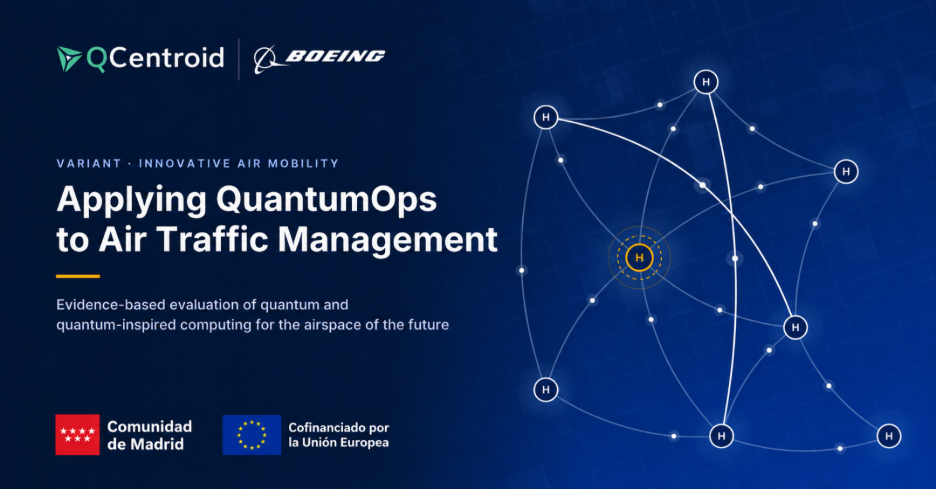
Innovative Air Mobility introduces a new class of aircraft into an airspace that was not designed for it. Electric vertical take-off and landing aircraft operating at low altitude in urban and suburban environments, at higher densities and with increasing levels of automation, place demands on air traffic management that current procedures and ground systems were not built to absorb. Making those operations scalable, as well as safe, is as much a computational challenge as an aeronautical one.
VARIANT (Validation of AiRspace Integration Applications and New Technologies), announced by Boeing Aerospace Spain in April 2026, was established to address that challenge by validating operational concepts, ground systems and enabling technologies together, through simulation and laboratory testing. QCentroid joined the consortium as the partner responsible for assessing the applicability of quantum and quantum-inspired computing to air traffic management and Innovative Air Mobility. This article sets out how that assessment is structured and what QCentroid is working on during 2026.
A consortium built on complementary specialisms
VARIANT requires distinct forms of expertise working within a shared validation environment to achieve its objectives. Boeing Aerospace Spain leads the program and, working with SkyGrid and Wisk, defines the concept of operations and develops the ground-based service layer, including vertiport resource management, traffic surveillance, and GNSS performance monitoring. ANZEN Engineering provides expertise in safety, security and systems engineering, including the assurance frameworks that future certifiable services will require. AI Methods contributes artificial intelligence applied to high-resolution meteorological forecasting for low-altitude operations. ENAIRE, CRIDA, UC3M and UPM contribute operational validation, air navigation expertise, and infrastructure.
QCentroid focuses on the computational dimension: a structured assessment of where emerging computational methods can offer measurable benefits to the digital services the partners are developing, together with the environment in which that assessment can be carried out reproducibly.
Computation as a limiting factor in air mobility
As airspace expands with the introduction of new stakeholders, for example drones and air taxis, coordination decisions that are today made by human operators following relatively static procedures will increasingly need to be supported, or taken, by autonomous systems and by more agile procedures. These systems must operate continuously under uncertainty and within increasingly stringent operational time constraints.
As airspace expands with the introduction of new stakeholders, such as drones and air taxis, coordination decisions that are currently made by human operators following relatively static procedures will increasingly need to be supported or taken by autonomous systems, using more agile procedures. These systems must operate continuously under uncertainty and within increasingly stringent operational time constraints.
Strategic traffic management following a contingency is a representative example. When a vertiport becomes temporarily unavailable, the schedule must be reorganized across the network. Flights may need to be delayed, resequenced, or cancelled, taking into account vertiport capacity, aircraft energy and turnaround feasibility, and the delay tolerance of passengers already in the system. Each decision affects the others, as changes at one vertiport can have consequences across the entire network, making timely decision-making essential.
Problems of this kind become increasingly complex as the number of aircraft, resources, and time slots grows. The number of possible allocations increases rapidly, while the time available to make operational decisions remains limited. Such problems are often considered potential candidates for quantum and quantum-inspired approaches, making rigorous evaluation essential. Whether these approaches can deliver measurable benefits in an operational aviation environment, and under what conditions, must be demonstrated through evidence rather than assumptions.
QuantumOps: Structured Evaluation for Regulated environments
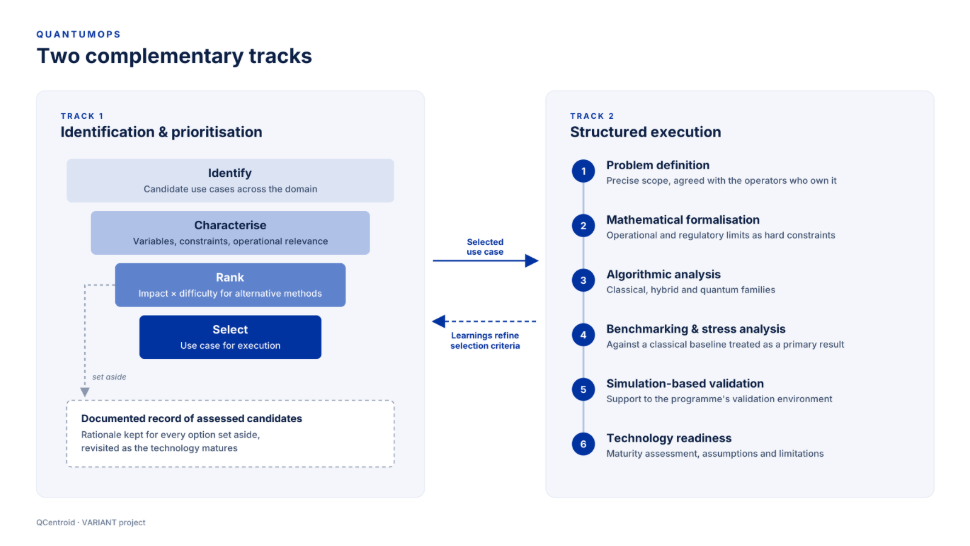
QuantumOps is QCentroid’s platform and methodology for the structured evaluation of advanced computational approaches. It was developed for organizations operating in complex and regulated environments, where the adoption of new computational technologies must be supported by measurable evidence, transparent benchmarking, and decisions that are justified, documented, and reviewable.
The methodology is structured around two complementary processes
The first is identification and prioritization. Candidate use cases are identified and assessed based on their key variables, constraints, operational relevance, potential impact, and the feasibility of applying alternative computational approaches. The outcome includes not only the selected use case but also a documented assessment of other candidates, together with the rationale for their selection or exclusion. This record can be revisited as computational technologies evolve.
The second is structured execution of a selected use case through a defined lifecycle: precise problem definition, mathematical formalization, evaluation of classical, hybrid, and quantum algorithmic approaches, comparative benchmarking and stress analysis, support for simulation-based validation, and technology readiness assessment.
The two processes reinforce each other. Insights gained from executing a use case help refine the criteria for identifying and prioritizing future opportunities.
Two aspects of this lifecycle are particularly important in aviation. First, mathematical formalization must account for operational and regulatory constraints, including aircraft separation requirements, energy and turnaround feasibility, and capacity limits. Any proposed solution must comply with these constraints, regardless of its computational efficiency, and the underlying model must be validated with the relevant operational stakeholders. Second, the classical baseline is considered a valuable outcome in its own right, rather than merely a reference for comparison. A well-defined classical model provides a reliable foundation for evaluating alternative computational approaches and can deliver useful results regardless of whether quantum methods demonstrate an advantage.
QCentroid’s work in VARIANT during 2026

In 2026, QCentroid’s contribution to VARIANT focuses on establishing the evaluation environment and executing the first selected use case through the QuantumOps lifecycle.
QCentroid is providing and extending QuantumLAB-IAM, the experimentation environment where different computational approaches are implemented, tested, and compared. The platform enables traceable and reproducible experiments, vendor-neutral access to quantum backends and high-fidelity simulators, and the management of hybrid computational resources. To adapt the platform to the specific needs of air mobility, three modules are being developed: multi-format data ingestion to integrate heterogeneous sources; advanced graphical visualization, including map, radar, and graph-based representations; and advanced experiment tracking.
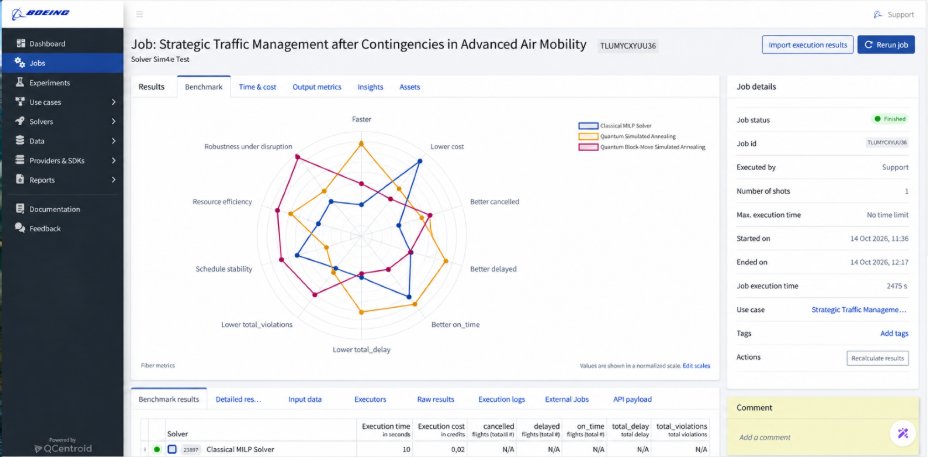
In parallel, QCentroid is applying its use case identification and prioritization methodology across the programme’s service domains, while executing the first selected use case: strategic traffic management following contingencies in advanced air mobility networks. This involves reorganizing flight operations after a disruption, minimizing delays and cancellations while considering vertiport capacity, aircraft energy requirements, turnaround feasibility, and flight sequencing. Supported by an established classical formulation and extensive published benchmarking literature, this use case provides a solid foundation for comparative evaluation.
During 2026, work on this use case includes problem formalization, implementation of the classical reference model, development of a hardware-agnostic quantum formulation, and comparative benchmarking against the classical baseline. The evaluation will use established performance metrics, including total delay, number of cancellations, and computation time. Defining these metrics and the classical reference model in advance ensures that results can be assessed objectively and consistently.
From formalization to evidence
VARIANT runs through 2028, with QCentroid’s contribution building progressively on the results of each phase. The current use case will be further refined through controlled laboratory experimentation, systematically evaluating different formulations, solvers, and hardware options under consistent conditions. In parallel, the identification and prioritization process will continue across the program’s service domains, exploring additional use cases and operational challenges as the project’s simulation environment evolves.
The aim is to build a body of evidence rather than deliver a single result. Together, the use cases evaluated throughout the program will help determine where quantum and quantum-inspired approaches can add value to Air Traffic Management and Innovative Air Mobility, under what conditions, at what scale, and at what level of technological readiness. The findings will be documented to support engineering teams, industrial partners, and regulatory stakeholders, with clear identification of the underlying assumptions and limitations.
“The future of advanced computing in critical industries will depend not only on technological breakthroughs, but on our ability to demonstrate real operational value. VARIANT is an opportunity to bring that discipline to aviation, working alongside leading industry partners to turn emerging computational capabilities into measurable evidence for future adoption.”
Carlos Kuchkovsky, CEO and Co-founder of QCentroid
VARIANT is partially funded by the Subdirectorate-General for Technological Innovation of the Madrid Regional Government under a public tender from the Regional Ministry of Education, through Orden 6234/25 granting VARIANT €3.75 million over the period 2026–2028, of which 40% is provided by the European Regional Development Fund (ERDF).