
The fundamental allure of quantum technology lies in a law of physics: it is impossible to observe a quantum system without changing it. In the context of communication, this means any attempt at interception is immediately detectable. This “observer effect” has turned quantum R&D into a high-stakes race, drawing intense interest not only from military commands but also from industries where data integrity is the lifeblood—most notably global banking and critical infrastructure.
In 2025, quantum technology decisively transitioned from theoretical physics into engineering standards and national security doctrines. For defense and aerospace firms, this marks the end of venture-backed experimentation and the beginning of rigid deadlines for infrastructure migration.
Historically, defense-funded “moonshots” have been the primary engines for civilian technological revolutions (the internet and GPS being the most prominent). We are seeing this pattern repeat today. As governments pour billions into national security agendas, they are effectively subsidizing the “Silicon Valley” of the 2030s, accelerating the development of dual-use technologies that will soon become standard for the general public.
The global quantum defense market has reached $2.9 billion this year, with a projected 14% CAGR, according to BIS Research. The primary driver is the urgent need to address GPS vulnerabilities and the “harvest now, decrypt later” threat to sensitive data with 20+ year secrecy requirements.
Key Areas of Dual-Use Quantum Technology
To cut through the noise, we evaluate quantum readiness using Technology Readiness Levels (TRL). This distinguishes between marketing “moonshots” and operationally deployable systems.
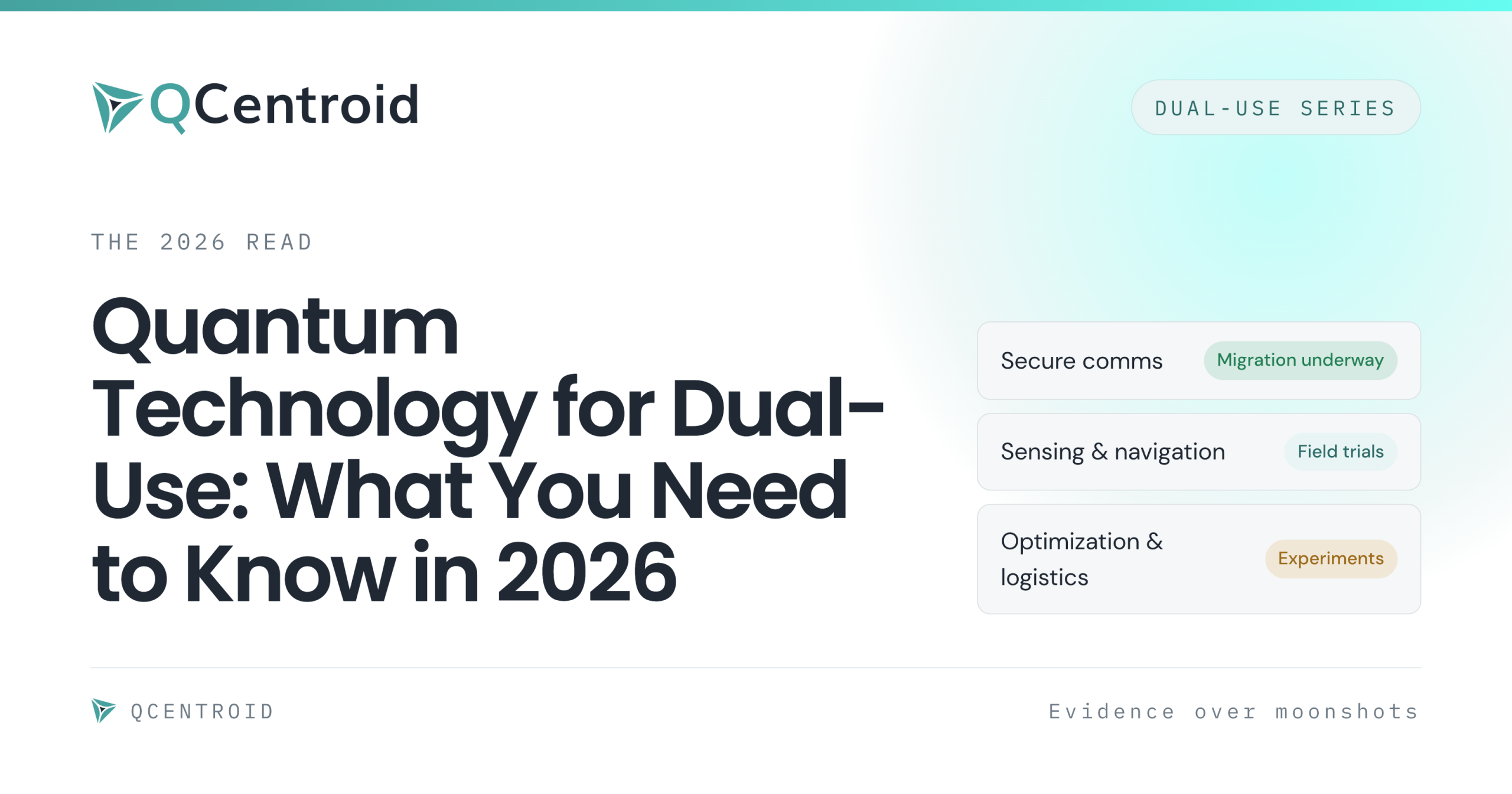
Secure Communications: PQC & QKD (TRL 4-8: Deployment)
By 2026, the risk of retrospective decryption has become a standard line item in defense risk assessments.
Quantum communication provides what is known as Information-Theoretic Security. Unlike current encryption, which relies on the mathematical difficulty of factoring large numbers, Quantum Key Distribution (QKD) relies on the physical properties of light.
- PQC (Post-Quantum Cryptography): NIST standards are now finalized. As of April 2026, deadlines to submit migration plans for US federal agencies are coming into force.
- QKD (Quantum Key Distribution): While China nears the 2027 launch of its “Dawn” geostationary satellite, the EU’s EuroQCI has activated its first commercial segments to secure cross-border government data.
- Defense & Banking: The ability to detect an eavesdropper instantly is why the European Union and China are building continent-scale QKD “backbones.”
Quantum Sensing & Navigation (TRL 6-7: Field Testing)
In modern electronic warfare, GPS signals are easily jammed or spoofed. Quantum sensors (specifically, atom interferometers) enable “Inertial Navigation” with zero drift. SIPRI notes that many of these technologies are reaching operational readiness. The U.S. Defense Intelligence Agency confirms that sensing and communications are approaching battle-ready maturity.
- The Solution: Quantum accelerometers and atom interferometers allow for navigation based on Earth’s gravitational and magnetic anomalies.
- Business Impact: By eliminating the “drift” inherent in classical Inertial Measurement Units (IMUs), submarines and UAVs can maintain centimeter-level precision for months without an external signal.
- The “No-Bullshit” Reality: SWaP (Size, Weight, and Power) constraints remain the bottleneck. These systems are currently viable for large platforms (frigates, strategic bombers) but are not yet miniaturized for tactical loitering munitions.
Quantum Scenario Simulations & Digital Twins (TRL 5–6: Active Piloting)
Classical Monte Carlo simulations are hitting a “complexity wall” in multi-domain operations. Quantum modeling allows mapping massive probabilistic variables directly onto quantum states to simulate outcomes in real time.
- The Direction: Defense labs, including AFRL, are piloting quantum-enhanced simulation for materials and chemistry R&D — the aim is to shrink the candidate space that classical methods must screen, and, with it, the multi-year discovery cycle. What’s not yet public is an audited, end-to-end time-saving: results so far are speed-ups on specific sub-problems, not program-level metrics.
- Dual-Use Impact:
- Defense: Modeling “Fog of War” iterations, accounting for simultaneous kinetic, cyber, and electronic warfare disruptions.
- Banking: Utilizing “Black Swan” market simulations to optimize capital reserves and systemic risk far beyond classical Value-at-Risk (VaR) models.
The Status: Moving from lab-bench theory to active field pilots.
Quantum Optimization & Logistics (TRL 4-5: Pilot Stage)
Using hybrid quantum-classical algorithms to manage complex theater logistics.
- The Reality: Optimization is where defense interest is highest, and proven advantage is thinnest. Hybrid quantum-classical solvers are being piloted for theatre logistics, but published results remain problem-specific and rarely beat well-tuned classical solvers at scale.
- The Benchmark That Matters: This is precisely what DARPA’s Quantum Benchmarking Initiative exists to settle. QBI runs in three stages (A → B → C); as of late 2025 it is in Stage B, where 11 companies are assessed against a 2033 utility-scale target, with independent verification & validation (Stage C) still ahead. Until that verdict lands, headline optimization percentages are vendor claims, not validated benchmarks.
Who’s Leading — Companies & Collaborations
Quantum Computing Firms
There isn’t a single “finalist” list yet, but the industry is focused on DARPA’s Quantum Benchmarking Initiative (QBI). The following teams have advanced to Stage B—the deepest public cut to date—aiming to produce utility-scale systems by 2033:
- Atom Computing & QuEra Computing – Neutral atoms.
- IBM – Modular superconducting processors.
- IonQ & Quantinuum – Trapped-ion architectures (QCCD).
- Diraq, Quantum Motion, & Silicon Quantum Computing – Silicon-based spin qubits (CMOS/MOS).
- Nord Quantique – Superconducting with bosonic error correction.
- Photonic Inc. – Optically linked silicon spin qubits.
- Xanadu – Photonic quantum computing.
Note: Quantinuum also provides “Quantum Origin” for hardened encryption keys, while D-Wave continues to supply quantum annealers for logistics optimization to defense actors like Lockheed Martin.
Quantum Sensing & Navigation
- Q-CTRL (Australia) — Ironstone Opal, magnetic-anomaly navigation. Field-validated in air, land and maritime trials, with DARPA and DIU contracts for next-generation sensors; the Royal Australian Navy’s MV Sycamore field-tested the system for shipboard navigation in GPS-jammed and GPS-spoofed conditions. In flight trials it outperformed the best competitive alternative by over 100x. Separately, the Australian Army has used Q-CTRL’s Fire Opal on convoy routing — a problem that can take over a month of classical computation for 120 convoys.
- SandboxAQ (US) — AQNav/MagNav. Holds a US Air Force contract for magnetic navigation; flown for 150 hours across the continental US aboard Airbus subsidiary Acubed’s flight-lab aircraft, producing continuous position fixes inside the FAA’s 2-nautical-mile en-route requirement and reaching ~550 m accuracy 64% of the time.
Worth stating plainly: both are magnetic-map matching plus AI, not cold-atom interferometry. The two get conflated in coverage and have completely different SWaP profiles and maturity curves.
Quantum Security & QKD Specialists
- ID Quantique (Geneva, Switzerland, acquired by IonQ) provides QKD systems, quantum-safe networking, and hardware-based quantum random number generators—deployments include early QKD for Swiss elections and record-breaking fiber QKD
- Quintessence Labs (Australia) develops QKD systems and quantum-secure hardware for generating randomness, backed by Australian Government defense grants.
- LuxQuanta (Barcelona, Spain) — continuous-variable QKD (NOVA LQ), designed to coexist with classical optical traffic on existing fiber infrastructure. Coordinator of the EU-funded QUARTER program and, since July 2026, QUARTERNEXT — a four-year effort to mature CV-QKD into certifiable, industrial-grade systems under the EuroQCI mandate. That is a certification project, not a research demo — which is the harder and more consequential step.
- Quside (Barcelona, Spain) — high-speed quantum random number generation. Within QUARTERNEXT, it supplies the QRNG entropy for cryptographic key generation across the consortium’s stack. Entropy is the least glamorous layer and the first thing certification bodies audit.
Public & Government-Funded Initiatives
Beyond startups, defense giants and alliances are operationalizing these technologies.
- Thales: Adopting a “pragmatic engineering” approach, Thales is deeply integrated into EuroQCI and is a key player in NIST’s PQC standardization (co-authors of the Falcon algorithm). Their focus is strictly on deployable cold-atom sensors for GPS-denied environments.
- Indra: leading NATO REPMUS exercises to validate QKD interoperability in the maritime domain, and managing the rollout of secure comms in Spain and Portugal.
- NATO: The alliance has formally adopted a “Quantum-ready” strategy. The focus is interoperability—ensuring that a quantum sensor on a British frigate can communicate with a US command center. The DIANA accelerator is now aggressively funding dual-use quantum pilots to bridge the “valley of death” between lab and battlefield.
- BAE Systems (UK): partnered with Infleqtion and QinetiQ on the UK MoD’s quantum navigation flight trials at Boscombe Down, testing an optical atomic clock and cold-atom inertial components aboard QinetiQ’s RJ100 demonstrator. In September 2025, BAE’s FAST Labs signed a three-year agreement with the US Air Force Research Laboratory on quantum sensing and networking, focused on combining multiple quantum RF sensors into arrays. Quantum Navigator
- Safran (France): the useful counterweight. Safran Electronics & Defense’s head of R&T for inertial navigation puts a possible introduction of quantum technologies more than ten years out, and the company has focused development on hemispherical resonator gyroscope (HRG) technology instead, on the grounds that quantum-based technology is not yet mature enough. When a prime with skin in the game says “not yet,” that is stronger evidence on TRL than any vendor deck. Aerospace Testing International
- Leonardo (Italy): active in EU Quantum Flagship sensing consortia and Italy’s national quantum programme, alongside its role in European PNT partnerships.
Global Trajectory & Regulatory Landscape (2026)
| Region | Strategic Priority | 2026 Regulatory Milestone |
| United States: From “Benchmarking” to Utility | The U.S. strategy has pivoted from experimental theory to industrial-scale engineering. | DARPA’s QBI: The Quantum Benchmarking Initiative (QBI) is now in a critical phase, aiming for fault-tolerant, utility-scale systems by 2033.National Standards: The NIST Post-Quantum Cryptography (PQC) standards are now the mandatory benchmark for federal agencies, forcing a massive private-sector migration to quantum-resistant encryption. |
| China: The QKD Superpower | Global QKD Coverage | Record Breakers: In early 2025, Chinese teams achieved a world-record 12,900 km quantum-secured link via satellite.The “Dawn” Satellite: China has announced the 2027 launch of “Dawn,” the first geostationary quantum satellite, which will provide 24/7 uninterrupted quantum coverage, bypassing the 9-minute window of current LEO satellites. |
| European Union | Strategic AutonomyThe EU is treating quantum as a critical infrastructure project to avoid dependency on U.S. or Chinese tech. | The European Quantum Act: proposal expected in 2026, with the Act itself now targeted for 2027.EuroQCI & Eagle-1: The European Quantum Communication Infrastructure (EuroQCI) is moving from pilot to operational status this year, supported by the launch of the Eagle-1 satellite to secure the bloc’s government communications. |
| India / Russia | Sovereign Standards | India’s Rapid RiseIn late 2025, India’s DRDO successfully demonstrated long-distance free-space QKD. This highlights a shift where “second-tier” quantum powers are skipping legacy infrastructure and moving straight to quantum-secure satellite communications.Russia: Indigenous Standards & Industrial PilotsRussia’s focus is on technological sovereignty, specifically developing domestic alternatives to Western standards.Indigenous PQC: Russia is developing its own quantum-resistant standards, such as the Shipovnik (Rosehip) algorithm. Russia frames this as protection against what it describes as potentially backdoored Western standardsHardware Roadmap: Rosatom has reported the completion of 50-qubit processors based on ions and neutral atoms, focusing on nuclear logistics and supply chain optimization. |
| Switzerland | Sovereign niche, regulator-led | Switzerland sits outside the EU and EuroQCI, so it is building its own posture. Its first national quantum strategy (Swiss Quantum Initiative, March 2026) flags the absence of a national QKD network and urges one that could later interconnect with EuroQCI. On the regulatory side, FINMA Guidance 05/2026 (July 2026) asks supervised financial institutions to hold a PQC migration roadmap by mid-2027 — aligned with the pan-European “Securing Tomorrow, Today” statement. On the ground, the Geneva Quantum Network (launched November 2025 by IonQ with CERN, Rolex and the Swiss government) is the country’s first dedicated quantum network. |
Reality-check corner – 2026
To make informed investment decisions, it is vital to acknowledge what quantum cannot do today:
- Breaking RSA-2048: Still impossible. To crack current encryption, we need millions of physical qubits with error correction. We remain in the NISQ (Noisy Intermediate-Scale Quantum) era, with a current ceiling of 1,000+ qubits.
- Run outside a hybrid workflow: In 2026 the QPU is one accelerator inside a hybrid quantum–classical pipeline, not a standalone machine. Classical HPC still carries most of the load and orchestrates the quantum step; the near-term production model is hybrid, cloud-delivered Quantum-as-a-Service (QaaS), not on-premise quantum replacing your HPC.
- On-Premise Costs: The overhead of cryogenic cooling and specialized maintenance makes on-premise hardware non-viable for most contractors. The immediate future is Quantum-as-a-Service (QaaS) via secured clouds (Azure, IBM, AWS).
Looking Ahead: Predictions for Industry Trajectory
| Timeframe | Expected Quantum Impact in Dual-Use |
| Now (0–2 years) | Quantum utility through hybrid quantum-classical systems: PQC deployment on the finalized NIST standards, QKD pilot links, early field trials of quantum sensors, and benchmarking schemes. |
| 2–5 years | Operational quantum sensors deployed on platforms, initial quantum-enhanced logistics tools emerge. |
| 10 years | Potential fault-tolerant quantum systems supporting advanced AI, global QKD networks, and material R&D. |
Closing Thoughts
Quantum in defense is a cycle of protection and optimization.
The communication layer (PQC now, QKD where it actually earns its place) is the part with hard deadlines; sensing and optimization are still proving, problem by problem, where they beat classical methods. The organizations that come out ahead won’t be the ones with the best slide decks — they’ll be the ones that knew which algorithms to migrate first, which pilots were worth funding, and which vendors would still be standing in five years.
QCentroid was built to help organizations make decisions with evidence rather than hype. Through our QuantumOps platform, defense and dual-use teams can test quantum and hybrid workflows against their real use cases, benchmark hardware across providers, and do it all in an environment that meets their security and sovereignty requirements.1
If any of this is on your desk right now, let’s talk.