
From use case to benchmark, with NVIDIA CUDA-Q
An operational pattern for enterprise hybrid quantum-classical workflows — from a business problem to a reproducible, comparable benchmark.
Enterprise quantum computing is moving past the isolated demo. For a growing number of teams the question is no longer “can we run a quantum algorithm?” It is a harder, more operational one: how does a team get from a business problem to a reproducible hybrid quantum-classical workflow, compare approaches fairly across classical, GPU-accelerated and quantum backends, and keep improving the experiment as hardware, solvers and understanding of the problem evolve?
That is an operations problem, not only an algorithms problem. It is the problem QCentroid’s QuantumOps practice is built around, and this article is about the operating model. The implementation details come from running QuantumOps at QCentroid with NVIDIA CUDA-Q as the execution substrate, but the pattern is meant to generalize.
This is the second piece in a short series. It builds on two earlier QCentroid articles: the QuantumOps cycle as a framework for quantum-computing adoption, and the integration that made NVIDIA CUDA-Q available inside the QuantumOps platform. The first set out the cycle; the second made the substrate available. This article takes the next step, how QuantumOps acts as the harness for expert quantum agents: the operating layer they run in to drive that cycle end to end, on top of CUDA-Q.
The enterprise bottleneck: from idea to executable, comparable workflow
Most enterprise quantum initiatives begin with a promising use case: portfolio or risk analysis, routing, scheduling, energy-system optimization, materials or molecular simulation, or fraud detection. Between that first business question and the first trustworthy benchmark sit a series of unglamorous steps: the problem has to be translated into a technical formulation; a data schema defined; a classical baseline chosen; quantum or hybrid approaches mapped to executable models; backends configured; experiments tracked; and results compared in a way business, technical and research stakeholders can all read.
Without an operating framework, that work scatters across notebooks, scripts, SDKs, spreadsheets and ad-hoc reports. The scatter produces some recurring failures:
- Reproducibility. Seeds, shot noise and optimizer initialization move results run-to-run; without recorded controls, a number is an anecdote, not a measurement.
- Comparability. Results are hard to line up across solvers, backends and time when each run is configured by hand.
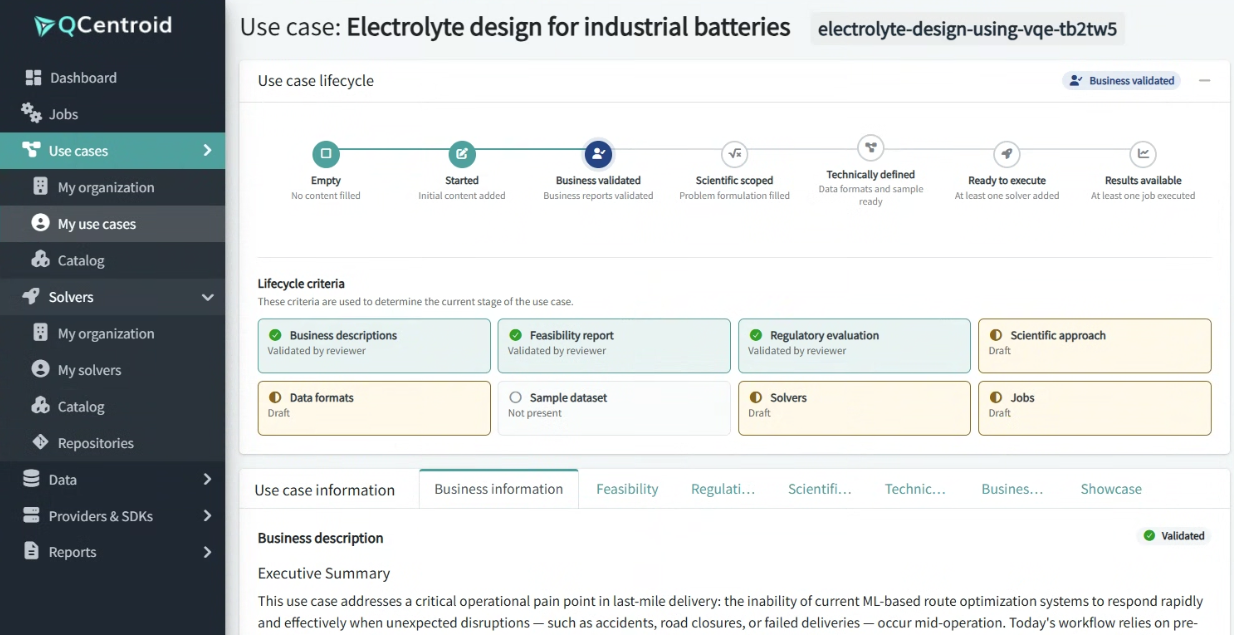
- Legibility. Decision-makers cannot tell whether progress is real, measured and worth the next round of scarce, costly hardware time.
A QuantumOps approach treats quantum experimentation as a managed lifecycle that also governs how agents and people collaborate — who proposed a step, who approved it, and what actually ran — so these failures are designed out rather than fought repeatedly.
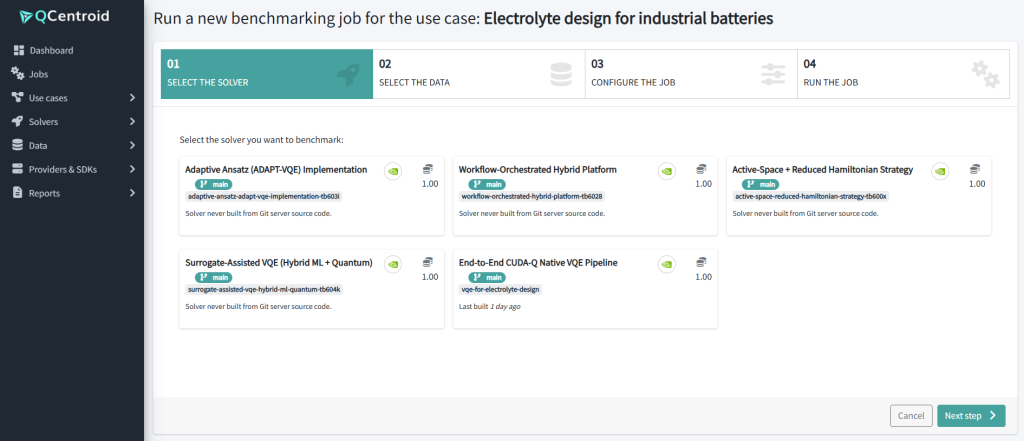
Figure 1. Benchmarking jobs: reproducibility and comparability across solvers, datasets and backends.
The QuantumOps cycle
QCentroid structures enterprise adoption as a continuous experiment cycle — Define → Model → Execute → Benchmark → Learn → Iterate — where each step produces artifacts that can be versioned, reused and compared. (The cycle itself is the subject of the first article in this series; here it is the spine the agents and the substrate hang on.)
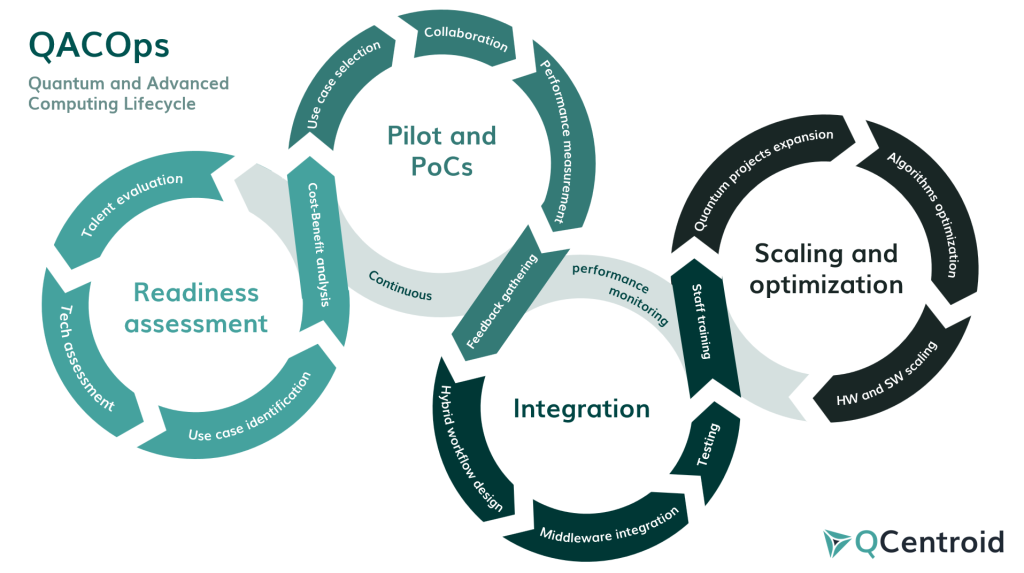
Figure 2. The QuantumOps cycle: Define → Model → Execute → Benchmark → Learn → Iterate.
A team starts by defining the use case: objective, constraints, datasets, expected outputs, the relevant KPIs and the business metric that will decide success. The problem is then modeled into a formal specification (an optimization model, a QUBO, a Hamiltonian, or a variational/hybrid routine) with an explicit input/output schema so that what is being solved is unambiguous and portable across teams. Candidate solver paths are selected (classical baseline, quantum-inspired, GPU-accelerated simulation, QPU validation), executed as tracked jobs, and benchmarked against a stated baseline. The team then learns from a comparable record and iterates. The value compounds: each experiment joins a growing evidence base that says what changed, why a result moved, and which configuration is worth testing next.
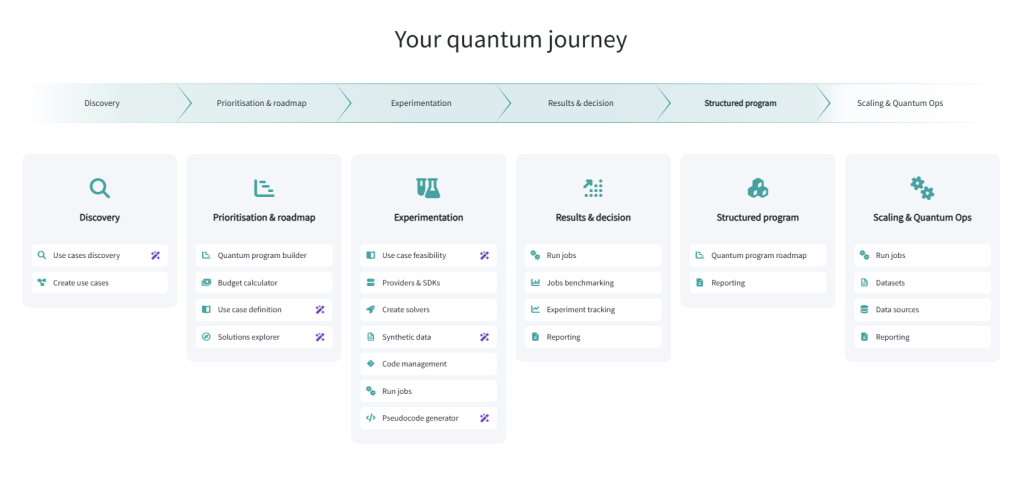
Figure 3. The QuantumOps journey and its per-stage tools across the platform.
QuantumOps: the harness for expert quantum agents
QuantumOps is the harness. It is the operating environment the expert quantum agents run in, it gives them the lifecycle to move through, the registry and traceability to record what they do, governed access to compute and data, and the guardrails that keep an accountable human in control.
QCentroid has developed and integrated a set of expert quantum agents into the platform, one for each step of the cycle, so a team can go from a business problem to a benchmarked result without re-inventing the workflow. Because the harness is what provides the lifecycle, governance and execution, it is not tied to those agents alone: the same cycle can drive expert agents created externally, by a customer’s own team, a partner, or the wider ecosystem, under the same controls. The harness is agent-agnostic by design; QCentroid’s agents are the ready-made default, not a lock-in. QCentroid’s broader multi-agent approach to quantum use cases is described here.
The agents do not replace quantum experts and they do not “do” the quantum computing; they remove the toil between a business intent and an executable, well-formed experiment, and keep a human at every decision that costs money or feeds a conclusion. A useful way to read the cycle is one expert agent per stage:
- Use-case builder agents. Turn a problem described in natural language into a structured use-case pack: business objective, technical objective, constraints, data schemas, candidate data, expected output, baseline methods, candidate quantum/hybrid approaches, benchmark criteria and success criteria.
- Modeling agent. Proposes initial formulations -decision variables, constraints, objective functions and candidate QUBO mappings for optimization; Hamiltonian construction and ansatz families for simulation- for an expert to review and own.
- Solver-path & development agent. Recommends candidate execution strategies -classical baseline, quantum-inspired method, GPU-accelerated simulation, a CUDA-Q hybrid workflow, or a QPU-validation step- and when each is worth its cost and generates executable code.
- Experiment-design agent. Fixes the benchmark before it runs: which solver versions to compare, which datasets and instances, which backend configurations, which metrics, dependent and independent variables, and which reproducibility controls.
- Benchmark-interpretation agent. Summarizes results, technical and business oriented, against the KPIs, baseline and proposes the next iteration: refine the model, change the optimizer/solvers, grow the instance, or compare against a stronger baseline.
The agents scaffold; people decide. That division -automate toil, not judgment- is what makes the loop fast without making it reckless, and it is the governance posture enterprises in finance, energy, healthcare and the public sector actually require.
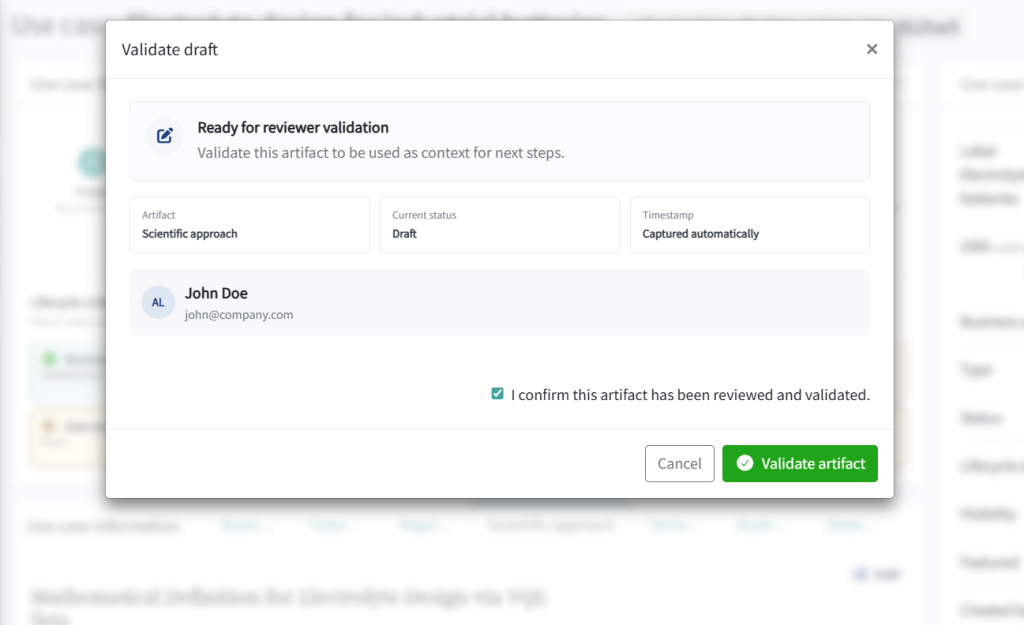
Figure 4. The agents scaffold; people decide
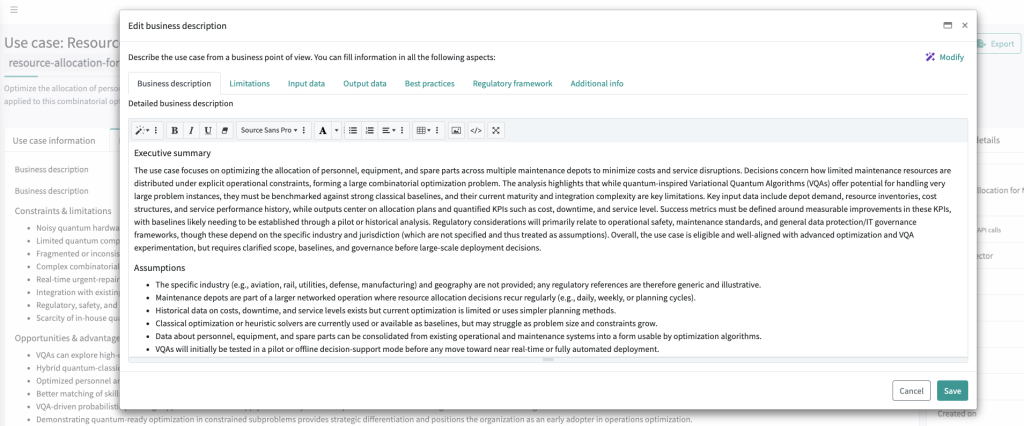
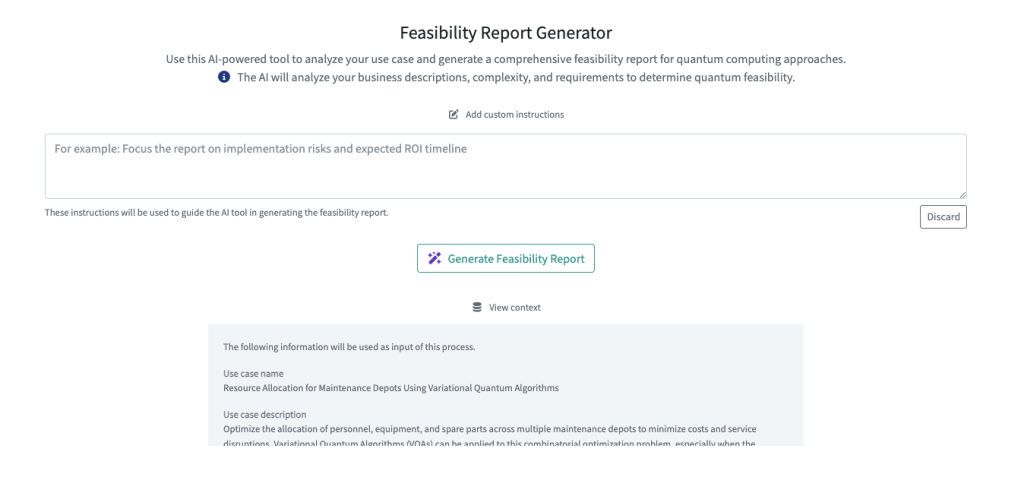
Figure 5. The use-case / feasibility agent turns a problem statement into a structured, feasibility-checked use-case pack for a human to approve.
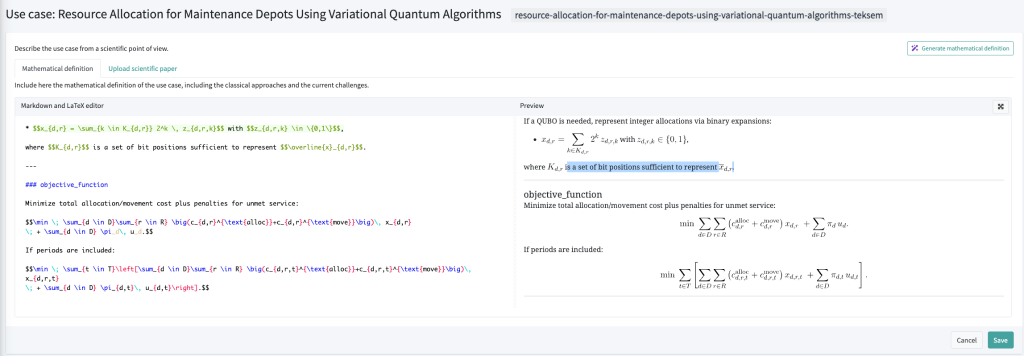
Figure 6. The modeling agent’s mathematical definition — objective function, constraints and QUBO formulation rendered from LaTeX, for an expert to review.
NVIDIA CUDA-Q as the execution and resource-access substrate
The agents and the cycle need somewhere to run, and this is where NVIDIA CUDA-Q is load-bearing. CUDA-Q is NVIDIA’s open-source platform and programming model for hybrid quantum-classical computing (it is software, not hardware). That abstraction is precisely what lets QuantumOps keep the science separate from the execution target and the solver portable: the backend becomes a parameter, not a rewrite.
For simulation, CUDA-Q draws on cuQuantum -cuStateVec for dense circuits and cuTensorNet for larger structured ones- so the experimentation engine scales on GPUs before any scarce hardware time is spent. In practice a solver keeps one entry point and selects its backend as a parameter, so the same code path runs in GPU-accelerated simulation during iteration and against a QPU for validation:
import cudaq

@cudaq.kernel
def ansatz(thetas: list[float]):
    q = cudaq.qvector(4)
    h(q)
    # ... problem-specific cost and mixer / variational layers ...

def run(use_case, solver_params):
    #
    # backend is a parameter, not a fork:
    #
    cudaq.set_target(solver_params.get("backend", "nvidia"))
    #   "nvidia" / "tensornet"  -> GPU-accelerated simulation (iterate)
    #   a QPU target            -> hardware validation (promote)
    # build the model, optimize parameters, sample the result
    return result
The point is not the code; it is the property the code has — one solver definition, many targets.
Within QuantumOps, CUDA-Q becomes the managed execution path: a team defines a hybrid workflow, runs it through CUDA-Q on a GPU-accelerated simulator (in QCentroid via the Launchpad, with no local driver or environment setup), captures the experiment’s metadata, compares it with other solver paths, and later validates the same workflow on an available QPU when it is justified. CUDA-Q accelerates and standardizes execution; QuantumOps operates the lifecycle around it. See the companion how-to on accelerating enterprise adoption with NVIDIA CUDA-Q via the Launchpad
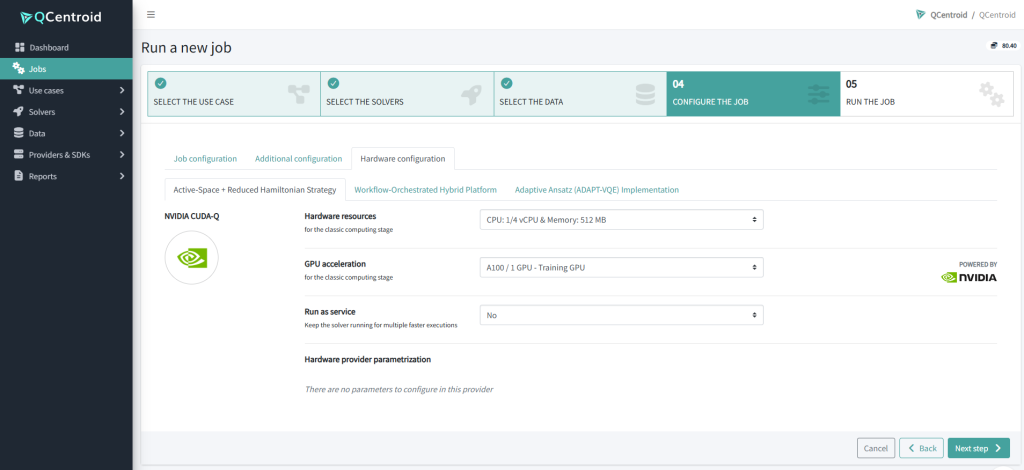
Figure 8. Run experiments on multiple devices and accelerated hardware.
How it fits together: from use case to benchmark
Take a domain-neutral example: a combinatorial allocation problem -assign limited resources under business constraints. The work is carried by the set of expert agents acting together across the cycle, not a single one. The builder and modeling agents turn the business description into a use-case pack (objective, technical objective, input/output schema, constraints, baseline methods, candidate approaches, metrics, success criteria) and a candidate formulation (here, a QUBO) for an engineer to review. The experiment-design agent then fixes the benchmark before anything runs:
- A fixed objective and a stated classical baseline (for example, a MILP or heuristic) on the same instances.
- A fixed instance set and dataset version.
- Agreed metrics, typically solution quality against the baseline and time-to-solution.
- Reproducibility controls: seeds, restarts the named simulator (state-vector vs tensor-network) and the GPU.
- The solver paths to compare: classical baseline, a CUDA-Q GPU-accelerated simulation path, and a candidate QPU-validation path.
Iteration happens in GPU-accelerated simulation; promotion to scarce QPU time is a deliberate, approved step, not a default. Every execution records its inputs, model and solver versions, backend, seeds, code version, logs, cost estimation and results, so a run is a versioned artifact rather than a transient notebook state. Because runs are declarative artifacts, the same experiment can be re-dispatched across backends for an apples-to-apples comparison, and a result from one quarter can be set beside the next without manual reconciliation.
A hybrid, heterogeneous problem
The next phase of quantum adoption is hybrid by design. Enterprises will not use QPUs in isolation; they will combine CPUs, GPUs, GPU-accelerated simulators, quantum backends, classical optimization, AI-assisted development and domain expertise. That makes orchestration, benchmarking and lifecycle management central rather than peripheral -the same concerns that already apply to any serious computational practice:
- Heterogeneous resource orchestration. The same experiment may run on a GPU state-vector simulator, a tensor-network simulator, or a QPU — each with different interfaces, capacities and failure modes — scheduled and tracked through one workflow.
- GPU-accelerated simulation as the engine. Most iteration happens in simulation, so simulation must scale and the simulation-to-hardware transition must be seamless.
- Reproducibility and provenance. Versioned, declarative runs with full provenance, so any result can be re-created.
- Cost estimation and energy-aware allocation. Scarce, costly compute means the cost and energy of each path should be estimated and visible before it is spent.
As GPU and quantum hardware move onto shared, low-latency fabric, the boundary between “simulate” and “run on hardware” becomes a configuration choice inside one hybrid program rather than a hand-off between systems. The operating principles above do not weaken in that world; they matter more, because faster and more heterogeneous execution raises the bar for reproducibility and disciplined benchmarking. That is the practical reason to build the practice on a portable and fundamentally hybrid substrate — NVIDIA CUDA-Q — today.
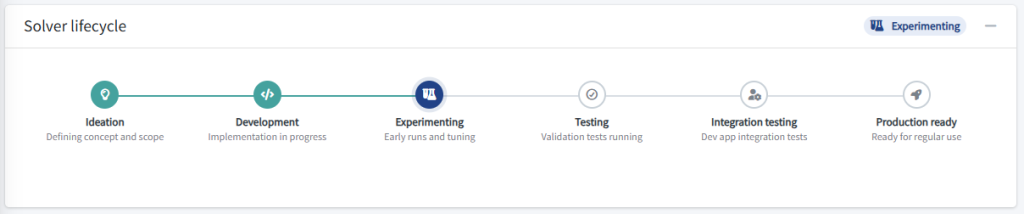
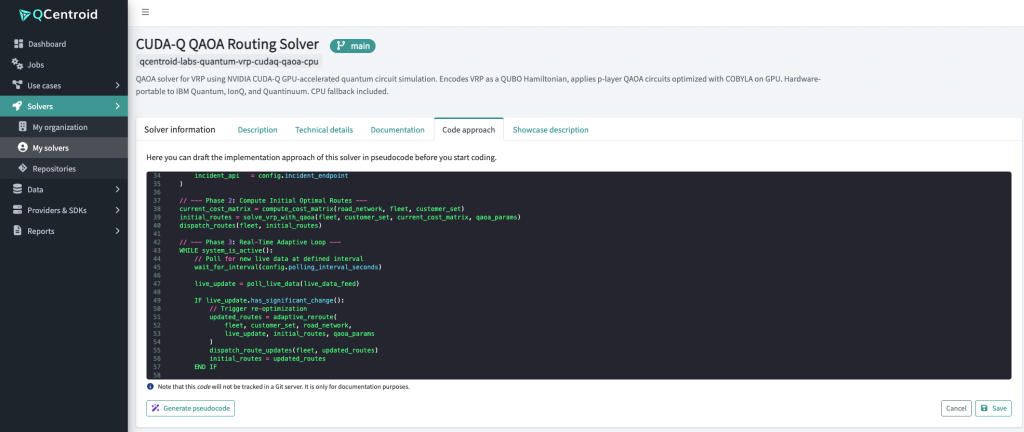
Figure 9. Solver development and deployment cycle
From isolated demos to institutional memory
Enterprise adoption is a disciplined iteration, not a single proof of concept. Teams need to test formulations, baselines, optimizers, ansätze, backends, data versions and problem sizes — and to understand not just which result is best but why, under which assumptions, and whether it reproduces. When a new backend appears, relevant experiments can be re-run; when a better solver is added, it can be compared against historical baselines; when the business problem changes, the use-case pack and schema evolve without losing the prior history. The output of the method is evidence, not anecdote: a versioned record of what was run, against which baseline, on which resource, at what cost, with what result — an institutional memory that informs which problem is worth the next experiment.
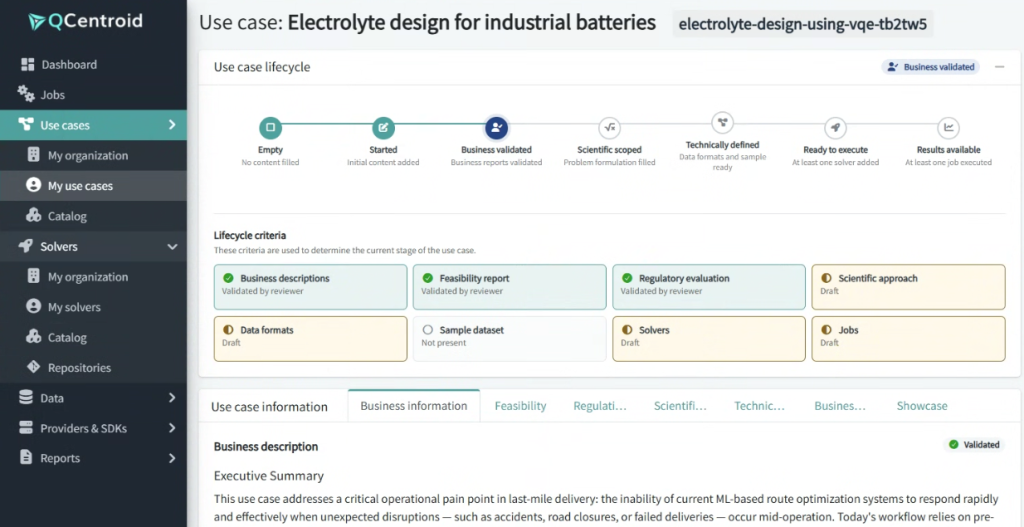
Figure 10. Use cases lifecycle: Agents & Humans – define, develop, approve.
The shift is concrete: from “we ran a quantum proof of concept” to “we operate a structured, governed program of hybrid quantum-classical experimentation.” Expert quantum agents lower the cost of entering and moving through the cycle; NVIDIA CUDA-Q provides the hybrid execution and GPU-accelerated simulation that make the cycle fast and portable; QuantumOps is the operating layer — lifecycle, registry, traceability, benchmarking and governance — that turns the two into a repeatable enterprise capability.
Today, expert quantum agents help organizations move faster through the experimentation lifecycle while maintaining governance, reproducibility and comparability. Looking ahead, increasingly coordinated agent systems may automate experiment generation, benchmark execution, model refinement and solver selection, creating the foundations for autonomous quantum laboratories operating at enterprise scale.